
Second opinions
An independent look at a reported finding or a condition that needs a closer review.
Services
Infrared inspections of electrical equipment in Chicago-area commercial, industrial, and institutional facilities.
John Sinkevicius scopes and performs the inspection. You receive clear reporting, with no corrective repair sales.
Equipment groups
Scope agreed per facility
01 / EQUIPMENT
From main distribution equipment to motor controls and transfer equipment.
02 / WHO WE WORK WITH
03 / ALONGSIDE AN EXISTING PROGRAM
You don’t need to replace them to use IID.
An independent look at a reported finding or a condition that needs a closer review.
A focused scan after corrective work to document whether the thermal pattern has changed.
Targeted inspections between scheduled visits for equipment your team depends on.
Extra coverage for a property, project, schedule gap, or defined maintenance concern.
04 / THE VISIT
John agrees the scope with your team, performs the inspection, and explains the report. If corrective work is needed, you choose the electrical professional who carries it out.
Before the visit
We plan the inspection around normal or representative operating conditions so the equipment can be assessed in context. Equipment that is unavailable, lightly loaded or not operating may need a different inspection window; relevant limitations are documented. The agreed scope will identify applicable load requirements.
Your facility arranges access to the rooms and equipment included in the inspection scope, along with any required escorts. Before the visit, we confirm the inspection route, operating schedule and available equipment identification or prior reports.
Where covers or doors must be opened to expose energized parts, that work is handled by qualified facility or electrical personnel under the applicable electrical safety program. Opening arrangements, responsibilities and safe access are agreed before the visit. Equipment that cannot be accessed safely is documented as limited or deferred.
We document reportable thermal findings with thermal and visible-light images, equipment identification and location. Evaluation considers comparable components, available operating/load information and relevant inspection history. Conditions affecting interpretation are recorded with the findings.
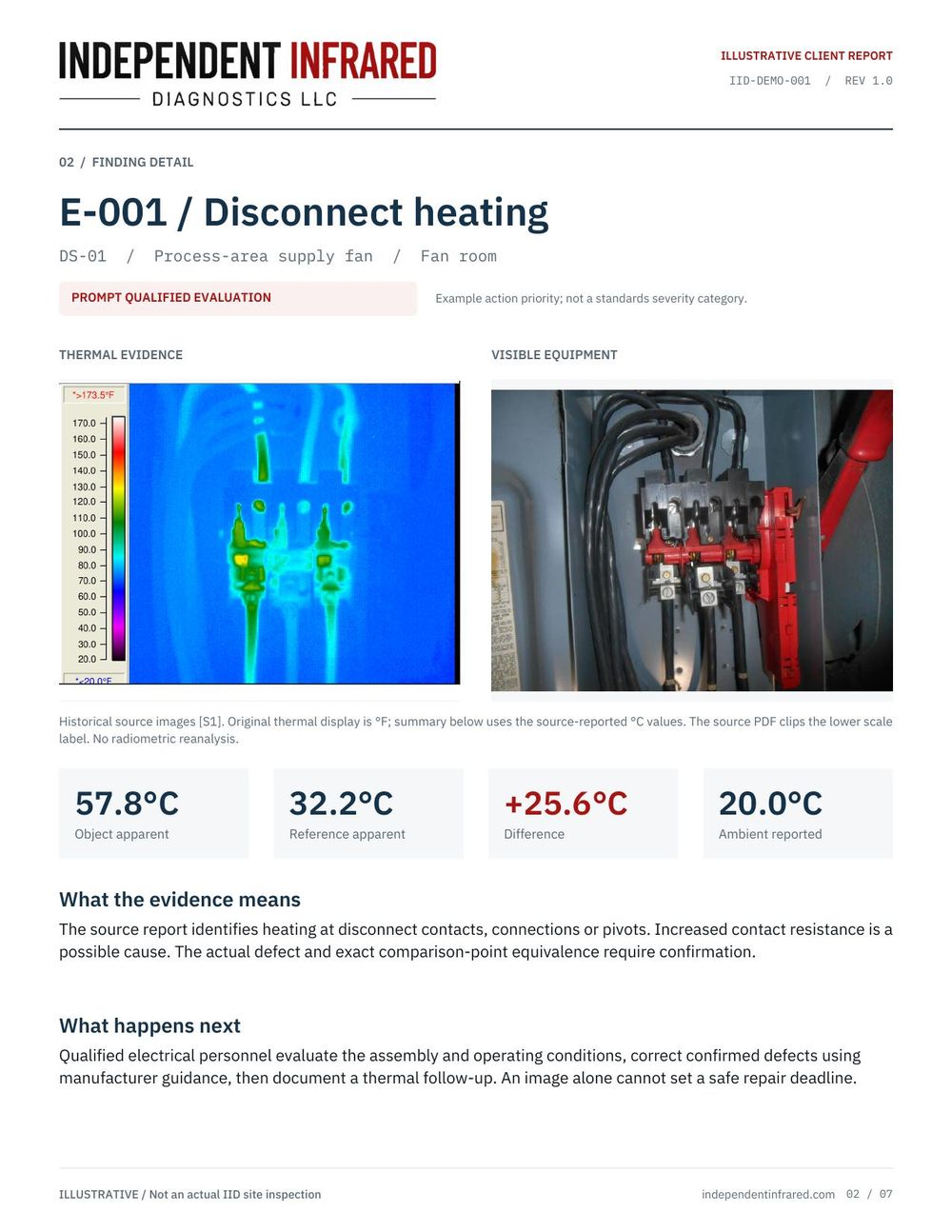
You receive a PDF report identifying the agreed inspection scope, equipment inspection status, reportable findings and recommended follow-up. Where applicable, findings include thermal and visible images, temperature comparisons, operating context and documented limitations. Report delivery timing is confirmed in the proposal.
When a finding needs follow-up
Not every inspection produces a finding that needs follow-up. Stages 04 and 05 apply when one does.
IID
John scans the equipment within the agreed scope.
IID
Thermal findings are documented with equipment references and locations.
IID
Your team receives images, findings, and recommended next steps.
Your chosen electrical professional
Your chosen electrical professional carries out any corrective work.
IID, when needed
IID can return for a separately scoped inspection after corrective work.
A separately scoped follow-up inspection records the same equipment after corrective work. The report documents the thermal pattern and the load, access, and operating conditions available for comparison.
Different operating conditions can affect the comparison. A changed thermal pattern alone does not certify that a repair is safe or compliant.
Illustrative verification example


THE DELIVERABLE
Review a sample before you book. See how equipment references, images, and recommended next steps are presented.
05 / INSPECTION SCOPE AND METHOD

Infrared thermography records apparent surface-temperature patterns that can help direct maintenance attention.
Operating load, surface emissivity, reflected temperature, viewing angle, and access affect the result. Relevant conditions and limitations are documented with the inspection.
A thermal pattern can warrant investigation; it does not establish a root cause by itself. An infrared inspection does not replace an engineering evaluation, certify code compliance, or perform corrective electrical work.
Tell John about your facility and the equipment you want inspected. Detailed lists and access arrangements can follow during scoping.